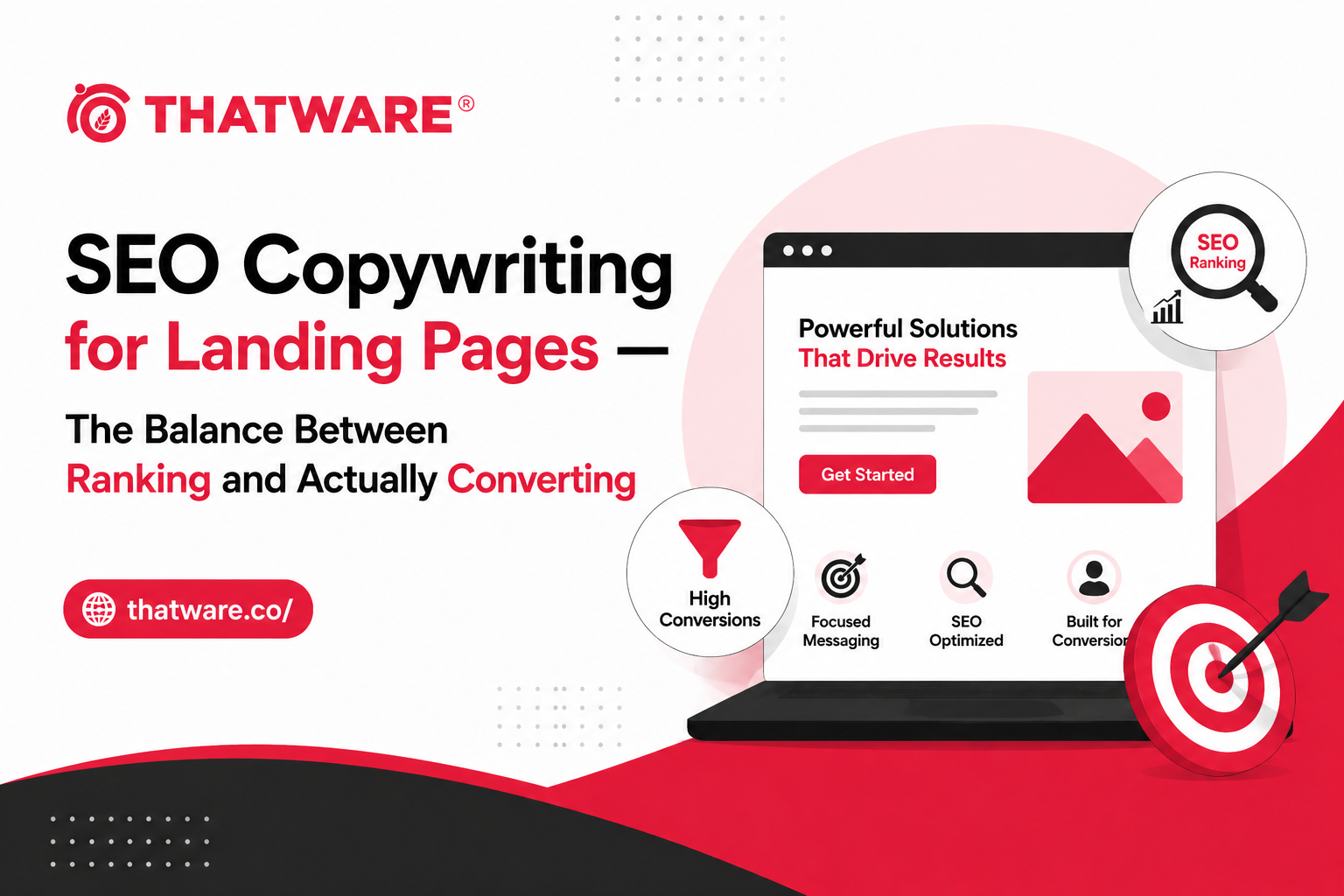
Landing pages occupy an uncomfortable middle ground in most marketing teams. The SEO team wants keyword density, semantic coverage, and content depth. The conversion team wants a clean, focused page with a single call to action and no distractions. The copywriter is caught between them, trying to satisfy both briefs without fully satisfying either.
This tension is real, but it’s often more resolvable than it appears. The assumption that SEO and conversion are inherently at odds on landing pages is based on an outdated model of what good SEO content looks like. When both disciplines are done well, they reinforce rather than undermine each other, because genuinely useful, clear, well-organized content tends to rank well and convert well simultaneously.
What Search Engines Actually Want from Landing Pages
The evolution of what ranks well has been moving steadily toward what genuinely serves users. A landing page that ranks primarily because it contains the target keyword in the right places but doesn’t actually answer the searcher’s question is increasingly vulnerable. Pages that genuinely address what someone searching that query actually needs are increasingly favored.
For commercial landing pages, this means clearly communicating what you offer, who it’s for, why it’s better than alternatives, and what the next step is. These are also, not coincidentally, the things that drive conversions. A page that makes its value proposition clear, addresses the main questions and objections, and makes it easy to take action is both a good SEO page and a good conversion page.
Where the conflict often actually lives is in content volume. SEO instincts push toward more content, more coverage, more signals. Conversion instincts push toward less friction, fewer distractions, cleaner pages. The resolution is being strategic about what content earns its place on the page versus what gets added to fill a content quota.
The Keyword Integration Problem
Forced keyword integration is one of the most common ways landing page copy gets damaged by misapplied SEO thinking. When keywords are inserted into copy in ways that don’t serve the reader, the writing gets awkward, the message gets muddled, and both ranking performance and conversion performance suffer.
Seo copywriting done well integrates target terms in ways that feel entirely natural because the copy is genuinely about the topic the keyword represents. If your page is actually about what the keyword describes, in substantive and useful ways, the keyword appears naturally at appropriate frequency without being forced.
The litmus test is straightforward: read the copy aloud without thinking about keywords. If it sounds like something a knowledgeable human would say to someone with the problem your product solves, it’s probably working. If it sounds like someone trying to work a phrase in, it needs revision.
Landing Page Architecture for Both Goals
The structure of a landing page affects both its SEO performance and its conversion performance, and the same structural choices often serve both.
Clear, specific headlines that communicate the value proposition tell both search engines and humans what the page is about. Organized information hierarchy with clear heading structure helps search engines understand content organization and helps scanners find the information they’re looking for. A wall of undifferentiated text serves neither goal.
Specific, substantive body copy that addresses the real questions a prospective customer would have, what does it do, who is it for, what results can I expect, how is it different from alternatives, is both more rankable than vague marketing language and more persuasive to actual buyers.
Social proof, case studies, testimonials, and specific outcome examples are conversion elements that also serve SEO by demonstrating specificity and real-world application that quality evaluation rewards.
The Technical SEO Layer
Seo content writing services for landing pages also include technical elements that need coordination with copywriting work.
Page speed is a ranking factor and a conversion factor simultaneously. Landing pages with slow load times lose both search rankings and conversions. Schema markup for product and service pages helps search engines extract and display structured information in search results, improving click-through rates from organic traffic.
Internal linking from high-authority pages to important landing pages improves their ranking potential. Making sure your most commercially important pages are receiving internal link equity from elsewhere on the site is one of the highest-ROI technical interventions for commercial page performance.
When the Goals Genuinely Do Conflict
Sometimes there is a real conflict, and it’s worth acknowledging rather than pretending the tension always resolves perfectly.
Some high-converting landing pages are very short, very focused, and optimized for a single action. These sometimes don’t have enough content to rank organically for competitive terms. The honest resolution in these cases is to have two versions: a paid traffic landing page optimized purely for conversion, and an organic landing page that provides more content depth and ranks better while still converting reasonably well.
Running both in parallel and sending paid and organic traffic to different versions is a legitimate strategy that serves both goals without forcing a compromise that undermines either. This approach requires more resources, but for high-value conversion targets in competitive categories, it often produces better outcomes than trying to optimize a single page for both objectives simultaneously.
The underlying principle is that good copywriting is good copywriting, whether the brief comes from an SEO team or a conversion team. Content that genuinely serves the reader tends to perform well on both dimensions. Content that serves neither tends to fail both. The gap between ranking and converting closes significantly when both briefs are built around the same foundation: saying something genuinely useful to the person reading it.